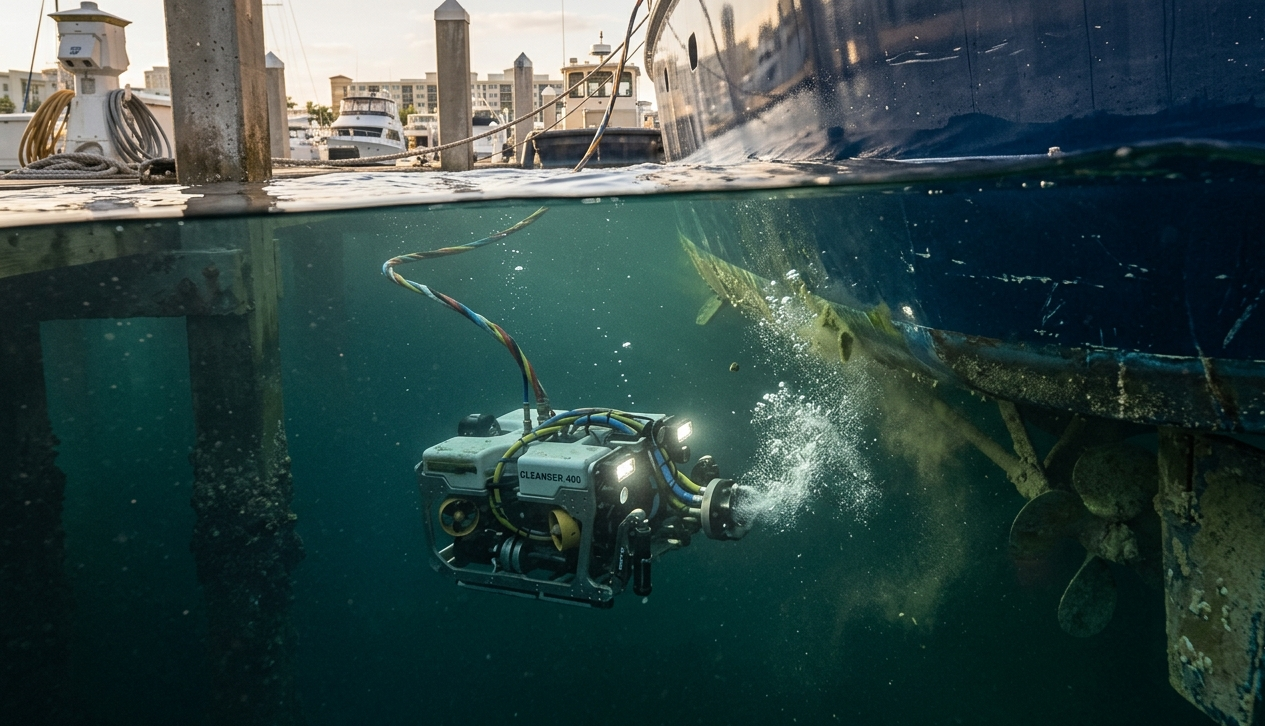
Deep-draft yachts create a practical challenge for underwater maintenance. Their hulls extend well below the surface, and reaching the lowest sections with conventional diver-based cleaning can become more complicated as depth, visibility, current, and vessel size increase. That is where ROV cavitation cleaning can provide another option for owners and marine maintenance teams.
An ROV, or remotely operated vehicle, is an unoccupied underwater robot connected to a surface operator through a cable. NOAA explains that ROVs can carry cameras, lights, sonar, and other equipment and are commonly used for underwater inspection where human diving is impractical or presents additional risk. :chatgpt-content-reference{index=”0″}
When an ROV is equipped with a suitable cavitation cleaning system, the same basic platform can potentially combine underwater observation with controlled marine-growth removal. For deep-draft yachts, that combination can be particularly useful when the goal is to inspect and clean difficult-to-reach hull sections without immediately taking the vessel out of the water.
What Is ROV Cavitation Cleaning?
ROV cavitation cleaning combines a remotely operated underwater vehicle with a controlled water-based cleaning system that uses cavitation to help detach marine growth. Cavitation occurs when pressure changes cause vapor bubbles to form in water and then collapse, producing localized cleaning energy near the surface.
The ROV provides positioning, cameras, lights, and remote control, while the cleaning system performs the physical removal of suitable fouling. The exact configuration varies by equipment and application.
The International Maritime Organization recognizes remotely operated vehicles as one of the technologies used for in-water cleaning and notes that different equipment may be required for flat surfaces, curved surfaces, and niche areas. :chatgpt-content-reference{index=”1″}
Why Deep-Draft Yachts Present a Unique Cleaning Challenge
A deep-draft yacht can have a substantial amount of underwater surface below the comfortable working depth of a routine dockside inspection. The lower hull may also have different fouling patterns from the waterline and upper sides.
- Greater underwater depth: The lowest hull areas can be difficult to access quickly during routine diver operations.
- Limited visibility: Turbid water can make it difficult for a diver or ROV operator to see the entire surface clearly.
- Large hull area: Luxury yachts can have substantial submerged surface area requiring systematic coverage.
- Complex appendages: Stabilizers, thrusters, rudders, intakes, transducers, and other fittings create additional niche areas.
- High-value coatings: A cleaning system must be compatible with the yacht’s antifouling or foul-release coating.
IMO guidance specifically identifies niche areas such as sea chests, bow thrusters, hull appendages, and protrusions as important parts of biofouling management. :chatgpt-content-reference{index=”2″}
How ROV Cavitation Technology Works on a Yacht
The basic process starts with inspection. The ROV is deployed and used to examine the underwater hull, establish the fouling condition, and identify fittings or sensitive areas that require special attention.
1. Conduct a Remote Hull Inspection
The first pass should establish what is actually beneath the waterline. Cameras and lighting allow the operator to document marine growth, coating condition, underwater hardware, and areas requiring closer inspection.
This is particularly valuable on a deep-draft vessel because the inspection can cover areas that are difficult to observe from the dock or surface.
A dedicated underwater inspection can also be performed when the owner needs a more comprehensive condition assessment before cleaning.
2. Identify the Fouling Type
Not all marine growth should be treated with the same cleaning intensity. A thin biofilm or slime layer is very different from mature barnacles, tube worms, or other hard calcareous fouling.
IMO distinguishes proactive cleaning of microfouling from reactive cleaning of more established macrofouling. Its current guidance emphasizes selecting equipment according to the fouling condition, coating, surface, and environmental circumstances. :chatgpt-content-reference{index=”3″}
3. Configure the Cleaning System
The cleaning head, operating parameters, ROV position, and cleaning pattern should be matched to the hull and coating. More power is not automatically better.
UMS guidance on cavitation cleaning similarly emphasizes controlled operation because jet pressure, angle, stand-off distance, coating condition, and fouling thickness can affect the cleaning result.
4. Clean in Controlled Passes
The ROV operator works methodically across the hull rather than repeatedly concentrating cleaning energy on a single point. Cameras provide continuous feedback so the operator can see whether the fouling is being removed and whether the underlying coating appears intact.
This combination of remote positioning and visual feedback is one of the practical advantages of robotic hull cleaning.
5. Perform a Post-Cleaning Inspection
After cleaning, the hull should be inspected again. The objective is to verify that unwanted fouling has been removed while identifying coating loss, damage, exposed substrate, or other underwater conditions that were hidden beneath the growth.
Underwater Drone Boat Cleaning: Where It Fits
The phrase underwater drone boat cleaning is often used to describe remotely operated underwater cleaning systems. Technically, an ROV is not an autonomous drone. It remains connected to the surface and is controlled by an operator.
That distinction matters because the quality of the operation still depends heavily on the person controlling the vehicle. An ROV does not independently understand whether a surface is a delicate sensor, a sound antifouling coating, a corroded fitting, or a structural defect.
Human supervision, inspection, and appropriate cleaning parameters remain essential.
Deep Draft Hull Maintenance Requires More Than Cleaning
Deep draft hull maintenance should be viewed as an ongoing condition-management program rather than a one-time cleaning event.
Marine growth can increase hydrodynamic resistance, and the IMO’s GreenVoyage2050 program identifies hull cleaning as a measure that can improve vessel hydrodynamic performance by removing biological roughness and fouling. It also notes that ROV systems can clean substantially larger flat-surface areas per hour than diver-operated cleaning in suitable applications. :chatgpt-content-reference{index=”4″}
For a luxury yacht, however, performance is only one consideration. Owners also need to protect coatings, running gear, underwater sensors, intakes, thrusters, and other expensive components.
ROV Cleaning vs. Diver-Based Hull Cleaning
ROVs and commercial divers are not necessarily competing technologies. The appropriate choice depends on the vessel, cleaning objective, access, water conditions, fouling, equipment, and local requirements.
| Consideration | ROV Cleaning | Diver-Based Cleaning |
|---|---|---|
| Deep underwater access | Can be useful where extended diver exposure is undesirable | Requires qualified divers and appropriate dive planning |
| Visual documentation | Camera-based inspection can be recorded during operation | Diver observations can be documented with video and photographs |
| Complex fittings | May require specialized ROV maneuverability or attachments | Diver can physically assess irregular or difficult areas |
| Large flat hull sections | Can offer efficient coverage with suitable equipment | Effective but potentially more labor-intensive |
| Hands-on assessment | Limited by cameras and vehicle capability | Provides direct tactile assessment by the diver |
IMO’s current guidance recognizes both diver-operated and remotely operated cleaning systems. It also emphasizes that the selected system should be appropriate for the surface, fouling level, coating, visibility, current, and water depth. :chatgpt-content-reference{index=”5″}
Protecting Yacht Coatings During ROV Cavitation Cleaning
One of the biggest mistakes in underwater cleaning is assuming that a coating is simply a barrier that can tolerate unlimited mechanical action.
IMO specifically warns that in-water cleaning can damage antifouling coatings, reduce coating service life, and release coating substances or other waste into the surrounding water. Its 2025 guidance emphasizes compatibility between the cleaning system and the coating being cleaned. :chatgpt-content-reference{index=”6″}
Before cleaning a deep-draft yacht, technicians should identify the coating type, condition, age when known, and any manufacturer-specific restrictions. Areas showing peeling, blistering, exposed substrate, or other deterioration may require a different maintenance decision rather than routine underwater cleaning.
Remote Hull Inspection Before and After Cleaning
A major advantage of combining inspection with ROV technology is documentation.
Before cleaning, the operator can record representative areas of fouling. After cleaning, the same areas can be reviewed again. This creates a useful visual record of what was removed and what condition was revealed underneath.
For yacht owners, captains, managers, and maintenance teams, that documentation can help with future maintenance planning. If a particular section repeatedly develops heavy fouling, the maintenance schedule can be adjusted based on observed conditions rather than guesswork.
Environmental Considerations for Robotic Hull Cleaning
ROV technology does not automatically make in-water cleaning environmentally harmless. The cleaning method can still release organisms, coating particles, sediment, or other material into the water.
IMO’s 2025 guidance recommends in-water cleaning with capture where appropriate to help protect the environment from removed coating substances and non-native organisms. It also identifies incomplete waste capture and untreated effluent as potential environmental risks. :chatgpt-content-reference{index=”7″}
Local rules can be stricter than international guidance. Some ports and marinas restrict or prohibit in-water hull cleaning because of contamination and biosecurity concerns. :chatgpt-content-reference{index=”8″}
Before scheduling an operation, verify the requirements of the marina, port, waterway, and applicable environmental authorities.
Common Mistakes With ROV Cavitation Cleaning
- Cleaning before inspecting: The condition of the coating and underwater equipment should be understood first.
- Using excessive cleaning intensity: Cavitation is a controlled cleaning method, not a reason to operate at maximum force.
- Ignoring niche areas: Thrusters, intakes, sea chests, rudders, and appendages can accumulate fouling differently from the main hull.
- Assuming an ROV can clean everything: Some areas still require diver access or specialized equipment.
- Skipping environmental planning: Removed fouling and coating debris may require capture and controlled disposal.
- Failing to document the finished surface: Post-cleaning video provides useful evidence of the actual result.
When Commercial ROV Services Make Sense
Commercial ROV services can be particularly useful when a yacht has substantial draft, difficult underwater access, extensive hull area, or a maintenance requirement where continuous visual documentation is valuable.
They can also complement diver-based work. An ROV may survey large areas of the hull while divers handle specific components or locations requiring direct hands-on inspection.
The most practical approach is often not about choosing technology for its own sake. It is about selecting the safest and most technically appropriate method for the actual vessel and task.
For compatible vessels and fouling conditions, cavitation cleaning can be incorporated into an underwater maintenance program. Conventional hull cleaning remains another option when the vessel, coating, and site conditions call for it.
Frequently Asked Questions About ROV Cavitation Cleaning
What is ROV cavitation cleaning?
ROV cavitation cleaning combines a remotely operated underwater vehicle with a controlled cavitation-based water cleaning system. The ROV provides remote positioning, cameras, and operator control while the cleaning system helps remove suitable marine growth from underwater surfaces.
Can an ROV clean a deep-draft yacht without divers?
In some applications, an ROV can perform inspection and cleaning without a diver physically working beneath the vessel. However, the appropriate approach depends on the hull, fouling, underwater equipment, ROV capabilities, local rules, and whether hands-on inspection is required.
Is robotic hull cleaning safe for antifouling paint?
It can be when the equipment and operating parameters are compatible with the coating. However, IMO warns that in-water cleaning can damage antifouling systems, so coating condition, cleaning intensity, fouling level, and equipment compatibility should be assessed before work begins. :chatgpt-content-reference{index=”9″}
Can ROV cavitation cleaning remove heavy barnacle growth?
It may be suitable for selected hard fouling, but the correct method depends on the fouling thickness, coating, substrate, equipment, and environmental requirements. Heavy mature fouling can require a different cleaning strategy from light microfouling.
Does ROV cleaning prevent marine biofouling?
No. Cleaning removes existing fouling but does not permanently prevent new growth. IMO notes that biofouling begins soon after a vessel enters the water and is influenced by operating profile, location, water temperature, salinity, coating condition, and maintenance history. :chatgpt-content-reference{index=”10″}
Building a Deep-Draft Yacht Maintenance Program
For a large yacht, underwater maintenance works best when inspection and cleaning are connected. Instead of waiting until fouling becomes severe, owners and yacht managers can establish condition-based inspections and document changes over time.
A maintenance program may include periodic remote inspection, professional hull cleaning, cavitation cleaning where appropriate, anode checks, running-gear inspection, and cleaning of underwater appendages.
Our underwater inspection service can help establish a documented picture of the submerged vessel, while zinc replacement can be scheduled when anodes require attention.
Read more practical yacht-care and underwater maintenance information on our marine maintenance blog.
Conclusion
ROV cavitation cleaning gives deep-draft yacht owners another way to approach underwater maintenance when vessel size, draft, access, or working conditions make conventional methods less practical. By combining remote inspection with controlled cleaning, the technology can help technicians work systematically while documenting the condition of the underwater surface.
The technology is not a substitute for judgment. Coating compatibility, fouling type, sensitive equipment, environmental rules, and the vessel’s actual condition must all be considered before cleaning begins. In some cases, an ROV will be the right tool; in others, diver-based inspection or conventional cleaning may be more appropriate.
The goal is straightforward: maintain a clean, well-documented underwater surface without creating unnecessary damage or environmental risk.
Ready to protect your vessel?
If you need expert help with this, our team of certified divers and marine technicians is ready to step in. Learn more about our specific services here.
Prefer to speak with an expert immediately? Contact us today to schedule a service or get a free quote!
