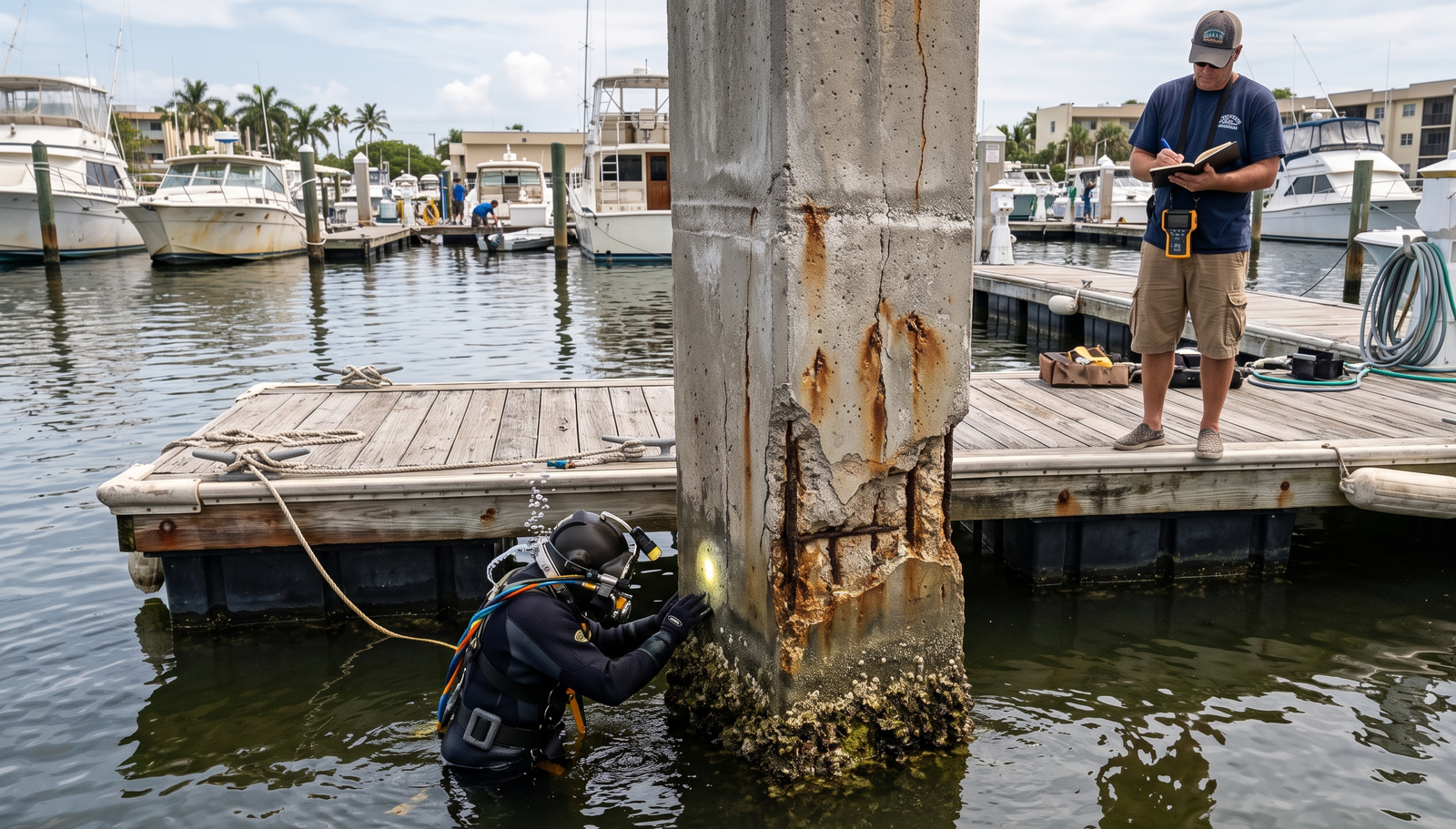
A concrete piling can look solid from the dock while corrosion is quietly developing inside it. A small rust stain, a crack along the concrete surface, or a patch of spalling concrete dock may be the first visible clue that embedded reinforcing steel is deteriorating.
For docks, piers, seawalls, marinas, and other waterfront structures, concrete piling rebar corrosion deserves early attention. Chlorides from seawater can penetrate concrete and eventually break down the protective environment around reinforcing steel. Once corrosion starts, the expanding rust products can create pressure inside the concrete, leading to cracking, delamination, and spalling.
We have seen plenty of situations where an owner notices a little orange staining and assumes it is simply an old-waterfront cosmetic issue. Sometimes it is. Sometimes it is the first visible sign of a much larger problem below the surface. The difference is determined by inspection, not appearance alone.
What Is Concrete Piling Rebar Corrosion?
Concrete piling rebar corrosion occurs when reinforcing steel embedded inside a concrete piling begins to corrode after its protective passive condition has been compromised. In saltwater environments, chloride ions are a major cause. As corrosion products build around the steel, they expand and can place pressure on the surrounding concrete, causing cracks, delamination, and spalling.
Intact concrete normally provides a highly alkaline environment that helps protect embedded steel. Over time, however, seawater can introduce chlorides into the concrete. If enough chloride reaches the reinforcement, the passive protection can break down and corrosion can begin.
That is why the visible condition of the concrete is only one part of the assessment. We also need to understand where the piling sits in relation to the water, how much concrete cover protects the reinforcement, and whether deterioration is concentrated around cracks or damaged areas.
Why Saltwater Concrete Pilings Are Vulnerable
Concrete pilings live in a demanding environment. They are exposed to saltwater, spray, changing water levels, oxygen, marine growth, and repeated wetting and drying.
The splash and tidal zones can be particularly vulnerable because they experience repeated exposure to both seawater and atmospheric oxygen. Chlorides can gradually move through the concrete toward the reinforcing steel, especially when the concrete is permeable or already damaged.
Several conditions can contribute to deterioration:
- Chloride penetration: Seawater provides a continual source of chloride ions.
- Cracked concrete: Cracks can provide pathways for water and chlorides.
- Permeable concrete: Higher permeability can allow aggressive substances to move deeper into the concrete.
- Limited concrete cover: Less cover provides less physical protection for reinforcement.
- Repeated wet-dry cycles: Tidal and splash areas repeatedly change between wet and exposed conditions.
- Existing concrete damage: Spalls and exposed reinforcement leave steel more directly exposed to the marine environment.
According to the Federal Highway Administration’s marine concrete research, chloride-induced corrosion is a major deterioration mechanism for reinforced concrete exposed to marine environments.
Early Warning Signs of Concrete Piling Rebar Corrosion
Corrosion does not usually begin with a dramatic failure. The structure often provides smaller warning signs first.
Rust Bleeding and Orange-Brown Staining
Rust bleeding seawall conditions can appear as orange, reddish, or brown streaks on the concrete surface. When staining appears around a crack or directly above an area of reinforcement, it deserves closer inspection.
Rust staining by itself does not tell you how much steel has been lost. It is a clue—not a complete diagnosis. We look at the staining together with cracking, concrete condition, exposure, and the location of embedded reinforcement.
Concrete Cracks Following Reinforcement
Concrete dock cracking becomes more significant when cracks follow the approximate path of reinforcing bars.
As steel corrodes, the corrosion products occupy more volume than the original steel. This expansion creates tensile pressure against the surrounding concrete. Eventually, that pressure can produce cracks running along the reinforcement.
A single random surface crack can have many causes. A network of longitudinal cracks accompanied by rust staining and deteriorated concrete tells a different story and warrants closer assessment.
Spalling Concrete
Spalling concrete dock conditions occur when pieces or layers of concrete detach from the surface. The visible damage may be small, but the deterioration behind it can extend farther than expected.
When corrosion causes concrete to crack and separate, the resulting opening can expose reinforcement to even more seawater and oxygen. This can accelerate further deterioration.
Delaminated or Hollow-Sounding Concrete
Not all deterioration is immediately visible. Concrete can separate internally while the surface remains relatively intact. This condition is commonly referred to as delamination.
Appropriate sounding and inspection techniques can help identify areas where the concrete has separated beneath the surface. The FHWA underwater inspection guidance discusses rust staining, cracking, spalling, and delamination as conditions that inspectors should evaluate on concrete structures.
How We Assess Concrete Piling Rebar Corrosion
A good inspection does not simply identify the biggest hole in a piling. It establishes a picture of the structure’s overall condition and identifies patterns that may indicate an active deterioration process.
1. Inspect the Splash and Tidal Zones
We pay close attention to the areas that experience repeated wetting and drying. These zones can receive heavy chloride exposure while also having access to atmospheric oxygen.
The waterline should not be treated as a hard boundary. Conditions above, at, and below the waterline can all provide useful information about the condition of the piling.
2. Map Cracks and Rust Stains
Document the location, length, direction, and pattern of visible cracks. Rust staining should also be mapped, especially where it follows cracks or appears near exposed reinforcement.
When an inspection is repeated later, this documentation provides a useful baseline for determining whether defects have changed.
3. Check for Delamination
A surface that looks intact may still contain separated or weakened concrete. Sounding and other suitable inspection methods can help identify these concealed areas.
This is one reason professional inspection can reveal more than a quick visual walk around the dock.
4. Examine Exposed Reinforcement
Where rebar is visible, the condition of the steel should be documented. Look for corrosion buildup, pitting, loose corrosion products, and apparent section loss.
The amount of visible rust does not automatically tell us how much structural capacity has been lost. If reinforcement section loss or structural deterioration is suspected, an appropriate engineering assessment may be required.
5. Document the Underwater Portion
A piling continues below the waterline, and that section can be difficult or impossible to evaluate from the surface.
Our underwater inspection services can document submerged conditions and help identify defects that would otherwise remain hidden beneath the water.
How Saltwater Rust Expansion Damages Concrete
Saltwater rust expansion is one of the central reasons corrosion becomes a concrete problem rather than simply a steel problem.
When reinforcement corrodes, the resulting corrosion products can occupy substantially more volume than the original metallic steel. That expansion creates pressure against the surrounding concrete.
The deterioration can progress in a cycle:
- Chlorides from seawater penetrate the concrete.
- The protective passive condition around the reinforcement breaks down.
- Steel begins to corrode.
- Corrosion products expand around the reinforcement.
- Concrete develops cracks or delamination.
- Concrete cover begins to detach.
- More reinforcement becomes exposed to seawater and oxygen.
Once this cycle becomes established, simply covering the visible stain may hide the symptom without addressing the source.
Common Conditions Found on Marine Concrete Pilings
| Visible condition | What it may indicate | What to investigate |
|---|---|---|
| Orange or brown staining | Possible corrosion near or behind the surface | Crack pattern, reinforcement location, and surrounding concrete |
| Longitudinal cracking | Possible corrosion-induced expansion | Rebar location, crack extent, and concrete cover |
| Concrete spalling | Possible advanced deterioration | Depth of damage and condition of exposed reinforcement |
| Hollow-sounding areas | Possible delamination | Extent of concealed concrete separation |
| Exposed reinforcing steel | Loss of protective concrete cover | Corrosion severity and potential steel section loss |
Common Mistakes When Dealing With Concrete Dock Cracking
Waiting Until Concrete Falls Off
Large spalls are usually not the beginning of the deterioration process. Cracking, staining, and delamination can develop first.
Waiting until pieces of concrete fall into the water can make the eventual repair more extensive and can create additional safety concerns around the structure.
Looking Only at What Is Above the Water
This is one of the easiest mistakes to make. From the dock, you can only see part of a piling.
Marine growth can also conceal defects below the waterline. Appropriate piling cleaning can sometimes help expose the concrete surface for closer inspection where growth is obstructing the inspection area.
Assuming Every Rust Stain Means Major Structural Damage
Rust staining should be investigated, but it should not automatically be treated as proof of severe structural deterioration. The extent, location, reinforcement condition, and overall defect pattern all matter.
Covering the Problem Without Finding the Cause
A surface patch may restore the appearance of a damaged area, but a durable marine concrete repair strategy should consider why the concrete deteriorated in the first place.
If active reinforcement corrosion remains behind the repair, the deterioration may continue.
DIY vs. Professional Marine Concrete Inspection
Owners can perform useful routine observations. Walk the dock, photograph new cracks, look for rust staining, and pay attention to areas where concrete is becoming loose or exposed.
But submerged deterioration is different. When the condition of a piling matters to the safety or continued operation of a dock, pier, seawall, or other waterfront structure, professional underwater inspection provides a much clearer view.
A qualified diver can examine the submerged surface, document defects, and identify areas that may require further engineering investigation.
Where marine growth is interfering with inspection, cleaning may be coordinated with the assessment. Depending on the surrounding equipment and structure, services such as cavitation cleaning may also be useful for removing appropriate marine buildup without relying solely on conventional mechanical methods.
Marine Concrete Repair After Corrosion Is Identified
The correct repair method depends on the actual condition of the piling. There is no universal patching solution for every marine concrete structure.
The assessment may need to consider:
- Depth and extent of concrete deterioration
- Condition and section loss of reinforcing steel
- Chloride contamination
- Concrete permeability and existing cover
- Marine exposure and tidal conditions
- Structural importance of the piling
- Whether corrosion is active or localized
For significant structural deterioration, a qualified structural or marine engineer should determine the appropriate rehabilitation approach. Repair may involve localized concrete removal and replacement, reinforcement treatment, protective systems, corrosion-control measures, or more extensive structural rehabilitation depending on the findings.
The goal should be more than making the piling look new. The repair should address the deterioration mechanism and restore the required performance of the structure.
How to Reduce Future Rebar Corrosion
For new marine concrete construction, long-term durability begins with appropriate concrete mix design, adequate reinforcement cover, construction quality, and measures that reduce chloride penetration.
For existing waterfront structures, regular inspection is the practical starting point. A documented baseline makes it easier to identify changes before deterioration becomes extensive.
Owners should pay particular attention to recurring cracks, new rust staining, exposed reinforcement, concrete delamination, and changes around the splash and tidal zones.
Early detection does not guarantee that expensive repairs can be avoided, but it gives owners more information and more time to plan an appropriate response.
FAQs About Concrete Piling Rebar Corrosion
Can saltwater cause rebar to rust inside concrete?
Yes. Chloride ions from seawater can penetrate concrete and eventually disrupt the protective passive condition around reinforcing steel. Once corrosion begins, expanding corrosion products can create pressure that causes cracking, delamination, and spalling.
What does rust staining on a concrete seawall mean?
Rust staining can be a warning sign of corrosion involving embedded reinforcement or another steel component. The stain alone does not establish the severity of deterioration, so the surrounding concrete and reinforcement should also be inspected.
Why does concrete crack around rusty rebar?
Corrosion products occupy more volume than the original steel. As they accumulate around reinforcing bars, they create pressure against the surrounding concrete. Continued expansion can produce cracks that follow the path of the reinforcement.
Is spalling concrete on a dock piling serious?
Spalling can indicate reinforcement corrosion or another deterioration mechanism. Its significance depends on its location, depth, extent, reinforcement condition, and structural role. Significant or expanding spalls should be professionally assessed.
Why is the splash zone vulnerable to rebar corrosion?
The splash and tidal zones experience repeated wetting and drying while remaining exposed to seawater and atmospheric oxygen. These conditions can be favorable for reinforcement corrosion in marine concrete, particularly when chlorides penetrate toward the steel.
Can marine concrete repair stop rebar corrosion?
Properly designed repair can restore damaged concrete and help control further deterioration, but the appropriate method depends on the cause and extent of corrosion. Active corrosion and chloride contamination may require more than a simple surface patch.
Read More: Explore more practical marine maintenance guidance and underwater service insights on our UMS marine maintenance blog.
Conclusion
Concrete piling rebar corrosion often provides warning signs before major deterioration becomes obvious. Rust staining, longitudinal cracking, delamination, exposed reinforcement, and spalling can all indicate that saltwater exposure is affecting the concrete and steel from within.
The best starting point is a proper condition assessment rather than simply covering the visible damage. By documenting what is happening above and below the waterline, owners can make better-informed decisions about maintenance, engineering evaluation, and marine concrete repair.
Regular underwater inspections can also establish a condition baseline, making it easier to recognize changes before a minor defect becomes a much larger waterfront maintenance problem.
Ready to protect your vessel?
If you need expert help with this, our team of certified divers and marine technicians is ready to step in. Learn more about our specific services here.
Prefer to speak with an expert immediately? Contact us today to schedule a service or get a free quote!
