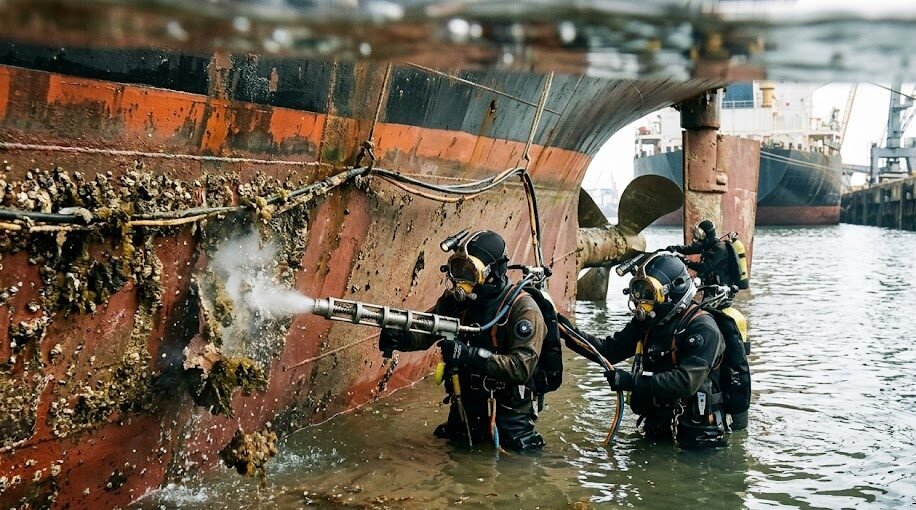
Commercial vessels operate in some of the harshest marine environments on the planet. From cargo ships and offshore support vessels to ferries and workboats, marine growth begins accumulating almost immediately after a hull enters the water. Barnacles, algae, slime, and shell organisms increase drag, reduce fuel efficiency, and raise operating costs. As shipping companies seek more sustainable maintenance solutions, acoustic shockwave marine cleaning is emerging as an innovative underwater cleaning technology that removes marine fouling while minimizing hull damage and reducing downtime.
Combined with experienced commercial divers and routine underwater inspections, acoustic shockwave technology offers fleet operators an efficient way to maintain vessel performance without frequent dry docking.
What Is Acoustic Shockwave Marine Cleaning?
Acoustic shockwave marine cleaning uses controlled acoustic energy and cavitation to remove marine growth from submerged hulls, propellers, and underwater structures. The technology generates microscopic vapor bubbles that collapse near fouled surfaces, releasing localized energy that breaks the bond between marine organisms and the hull without the aggressive abrasion associated with traditional scraping methods.
This process is especially valuable for commercial vessels where preserving antifouling coatings while maintaining operational efficiency is a top priority.
The International Maritime Organization (IMO) recognizes effective biofouling management as an important strategy for improving vessel efficiency, lowering greenhouse gas emissions, and reducing the spread of invasive aquatic species.
Understanding Underwater Cavitation Physics
The science behind underwater cavitation physics is surprisingly straightforward. When rapid pressure changes occur in water, microscopic vapor bubbles form and collapse almost instantly. These tiny implosions generate concentrated bursts of energy that safely dislodge marine growth attached to underwater surfaces.
Unlike mechanical scraping, cavitation targets the fouling itself rather than aggressively wearing away the protective coating beneath it. This makes the technology particularly useful for maintaining modern antifouling systems.
How Acoustic Shockwave Cleaning Works
Professional divers position specialized acoustic cleaning equipment near fouled underwater surfaces. Controlled acoustic pulses create localized cavitation that removes:
- Slime layers
- Algae
- Barnacles
- Tubeworms
- Mussels
- Biofilm accumulation
The equipment is carefully operated to match the vessel’s coating type, fouling level, and maintenance objectives.
Benefits for Commercial Hull Maintenance
Routine commercial hull maintenance plays a major role in reducing operating costs across commercial fleets.
Improved Fuel Efficiency
Marine fouling increases hydrodynamic drag, forcing engines to burn more fuel to maintain service speed. A cleaner hull restores smoother water flow and improves efficiency.
Reduced Dry Dock Frequency
Regular underwater cleaning helps extend the interval between major maintenance periods, reducing operational disruption.
Protection of Antifouling Coatings
Properly performed acoustic cleaning minimizes unnecessary wear on modern hull coatings, helping preserve their protective properties.
Lower Lifecycle Costs
Maintaining clean hulls reduces fuel consumption, mechanical loading, and long-term maintenance expenses across an entire fleet.
Hydrodynamic Cavitation Boat Performance Benefits
Maintaining a clean hull directly improves hydrodynamic cavitation boat performance by reducing resistance between the vessel and surrounding water.
Fleet operators often observe:
- Lower fuel consumption
- Improved cruising efficiency
- Reduced engine loading
- Better schedule reliability
- Lower greenhouse gas emissions
- Improved propeller performance
The National Oceanic and Atmospheric Administration (NOAA) notes that marine biofouling significantly affects vessel performance while contributing to the transfer of invasive aquatic species.
Large Vessel Cleaning Without Dry Docking
One of the biggest advantages of large vessel cleaning is that many underwater maintenance procedures can be completed while the vessel remains afloat.
This allows operators to:
- Reduce operational downtime
- Avoid unnecessary dry dock scheduling
- Maintain tighter shipping schedules
- Perform preventative maintenance year-round
- Improve fleet availability
Professional Hull Cleaning services help remove marine growth before it significantly affects vessel efficiency.
The Role of Commercial Diving Cavitation
Commercial diving cavitation combines experienced underwater technicians with specialized cleaning equipment capable of treating complex hull geometries and propulsion systems.
Commercial divers routinely inspect and clean:
- Hull plating
- Propellers
- Rudders
- Bow thrusters
- Sea chests
- Intake grates
- Stabilizers
Professional Cavitation Cleaning is particularly effective for delicate underwater metal components where minimizing surface damage is essential.
Supporting Fleet Maintenance Programs
Acoustic cleaning delivers the best results when integrated into a comprehensive maintenance strategy.
Routine Underwater Inspections
Regular Underwater Inspection services identify coating damage, corrosion, marine growth, and mechanical issues before they affect vessel performance.
Corrosion Protection
Routine Zinc Replacement helps protect underwater metals from galvanic corrosion while maintaining propulsion system reliability.
Common Mistakes Fleet Operators Make
- Waiting until heavy fouling develops before scheduling cleaning.
- Using overly aggressive cleaning methods that damage coatings.
- Ignoring underwater inspections between dry dockings.
- Overlooking propellers while focusing only on hull surfaces.
- Delaying corrosion protection maintenance.
- Failing to document hull condition over time.
Frequently Asked Questions
What is acoustic shockwave marine cleaning?
Acoustic shockwave marine cleaning uses controlled acoustic energy and cavitation to remove marine growth from underwater surfaces while helping preserve antifouling coatings and hull integrity.
How does cavitation remove marine growth?
Microscopic vapor bubbles form and collapse near fouled surfaces, releasing localized energy that breaks the bond between marine organisms and the hull without relying on aggressive abrasion.
Is acoustic cleaning suitable for commercial vessels?
Yes. It is well suited for commercial ships, ferries, offshore support vessels, and other large vessels where minimizing downtime and maintaining hull efficiency are important operational goals.
Can acoustic cleaning replace dry docking?
No. While underwater cleaning helps extend maintenance intervals and reduce fouling, vessels still require scheduled dry dock inspections and repairs according to regulatory and operational requirements.
How often should commercial vessels receive underwater cleaning?
Cleaning frequency depends on operating routes, water temperature, vessel speed, antifouling coating type, and local fouling conditions. Routine inspections help determine the appropriate maintenance schedule.
Looking for more expert marine maintenance insights? Visit our blog for additional guides on underwater inspections, hull care, and commercial diving services.
Conclusion
Acoustic shockwave marine cleaning represents an important advancement in commercial fleet maintenance by combining modern cavitation technology with professional underwater expertise. As shipping companies continue seeking safer, more efficient, and environmentally responsible maintenance solutions, acoustic cleaning offers an effective way to reduce marine fouling, improve fuel efficiency, preserve antifouling coatings, and support long-term fleet performance without unnecessary operational downtime.
Ready to protect your vessel?
If you need expert help with this, our team of certified divers and marine technicians is ready to step in. Learn more about our specific services here.
Prefer to speak with an expert immediately? Contact us today to schedule a service or get a free quote!
