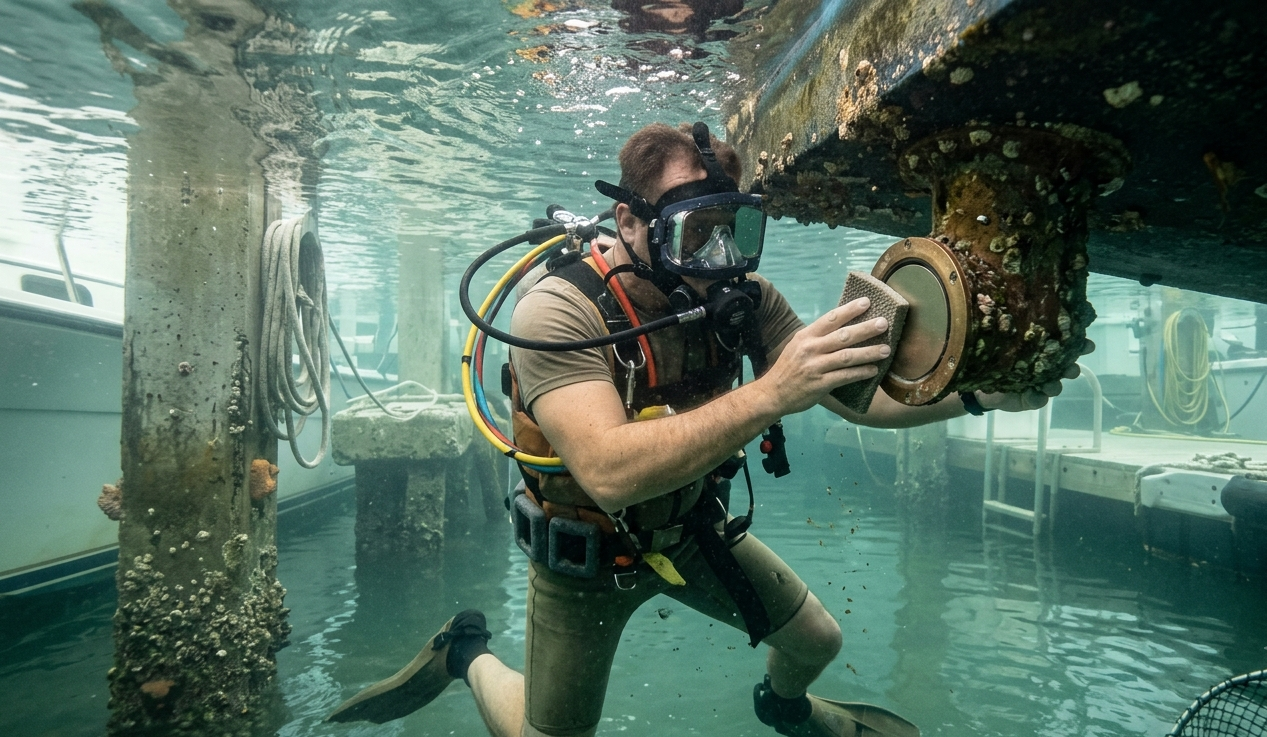
Your fish finder can be working perfectly while the transducer underneath the boat is struggling to send and receive a clean signal. A layer of algae, barnacles, slime, or hard marine growth can interfere with sonar performance and turn a normally reliable depth sounder into a frustrating guessing game.
Sonar transducer fouling is especially common on boats that stay in the water for extended periods. We see it on fishing boats, center consoles, yachts, and commercial vessels operating in warm saltwater. Even a relatively thin layer of growth can affect the transducer face, while aggressive scraping or harsh chemicals can damage the sensor you are trying to protect.
The solution is not simply to attack the growth with the strongest tool available. Transducers are precision marine electronics, and cleaning them requires a different approach from cleaning a hull or propeller.
What Is Sonar Transducer Fouling?
Sonar transducer fouling is the buildup of marine organisms, algae, slime, barnacles, calcium deposits, and other underwater debris on the surface or housing of a sonar transducer. This buildup can interfere with acoustic transmission and reception, reducing depth readings, fish-finder performance, and bottom-detail quality.
Garmin specifically warns that aquatic fouling can accumulate quickly and reduce transducer performance, while Simrad identifies a heavily fouled transducer as one possible cause of depth-sounder and fish-finder problems. :contentReference[oaicite:0]{index=0}
Why Marine Growth Affects a Boat Transducer
A transducer works by sending acoustic energy through the water and receiving returning signals. The surface that contacts the water therefore matters.
When marine organisms cover that surface, they can interfere with the clean transmission and reception of the sonar signal. The result may show up as:
- Inconsistent depth readings
- Missing or weak bottom returns
- Reduced fish-finder detail
- Intermittent sonar performance
- Difficulty tracking the bottom
- More noticeable performance problems at certain speeds or in disturbed water
Garmin notes that the transducer should be clear of fouling and scratches to obtain a depth reading. Simrad likewise recommends checking for heavy fouling when troubleshooting depth-sounder problems. :contentReference[oaicite:1]{index=1}
What Does Fish Finder Marine Growth Look Like?
Fish finder marine growth does not always look dramatic. Early fouling may appear as a thin layer of slime or algae. As the boat remains in the water, barnacles and other organisms can develop into harder, more firmly attached growth.
In South Florida’s warm marine environment, growth can establish quickly, particularly on boats that remain docked between trips.
Look closely for:
- Green, brown, or gray slime
- Algae film
- Small barnacles
- Calcareous deposits
- Hard shell growth
- Marine debris stuck around the transducer
- Scratches or physical damage to the transducer face
The important distinction is between removing fouling and damaging the transducer while removing it. The second problem can be much more expensive.
How to Clean a Boat Transducer Safely
If you want to clean boat transducer surfaces yourself, start with the least aggressive method recommended for your specific model.
1. Check the Manufacturer’s Instructions
Transducer construction varies considerably. A through-hull Airmar unit, a transom-mounted fish-finder sensor, and a scanning sonar transducer may have different cleaning and antifouling requirements.
Do not assume that a cleaning method suitable for one sensor is safe for another. Airmar also provides certified installer resources for model-specific installation and technical support. :contentReference[oaicite:2]{index=2}
2. Start With Fresh Water and a Soft Cloth
For light fouling, a soft cloth and mild detergent are often the appropriate starting point. Garmin’s general transducer guidance recommends a water-dampened cloth and mild detergent and warns that chemical cleaners can damage some transducer materials. :contentReference[oaicite:3]{index=3}
Work gently rather than trying to remove everything in one aggressive pass.
3. Use a Non-Metallic Cleaning Pad for Heavier Growth
When growth is more established, the manufacturer’s instructions may permit a non-metallic scouring pad or suitable cleaning pad.
Garmin’s instructions for several transducers recommend a non-metallic scouring pad or putty knife for severe fouling, while other Garmin guidance specifies a scratch-free pad. The exact recommendation depends on the model. :contentReference[oaicite:4]{index=4}
That distinction matters. Do not automatically transfer a cleaning method from one transducer model to another.
Why Sharp Scrapers Can Damage the Sensor
One of the biggest mistakes we see is treating a transducer like a propeller or metal fitting.
A metal scraper may remove a barnacle quickly, but it can also scratch the transducer face. Those scratches can affect performance and create another surface where fouling can establish.
Garmin specifically advises against sharp tools or scrapers that can scratch the face of the transducer or potentially affect the mounting area. :contentReference[oaicite:5]{index=5}
If your particular manufacturer’s instructions allow a non-metallic tool for severe fouling, follow those instructions carefully. Otherwise, use a softer cleaning method or have the sensor professionally serviced.
Never Use Harsh Solvents Without Checking the Manual
Solvents can be particularly risky because they may attack plastics, coatings, seals, or other sensor materials even when the surface initially looks fine.
For example, Garmin specifically warns against solvents such as acetone, mineral spirits, and MEK on certain transducers. Garmin also states that acetone can damage plastic transducer housings. :contentReference[oaicite:6]{index=6}
Raymarine guidance similarly warns that acetone can damage transducers and advises against ketone-based paint on applicable models. :contentReference[oaicite:7]{index=7}
So if you are wondering whether a strong marine solvent will make underwater sensor cleaning faster, the safer answer is to check the exact manufacturer’s instructions first.
What About Pressure Washing a Transducer?
Pressure washing may be appropriate for some areas of a vessel, but that does not mean it is appropriate for a precision sonar sensor.
Garmin explicitly instructs users not to use a power sander or pressure washer to clean certain transducers because of the risk of permanent damage. :contentReference[oaicite:8]{index=8}
The same principle applies to aggressive rotary tools. Removing marine growth quickly is not useful if the cleaning process damages the transducer face, housing, cable, or mounting system.
How to Deal With Depth Sounder Barnacles
Depth sounder barnacles are among the more stubborn forms of fouling because they attach firmly and can build a rough layer over the sensor.
For light barnacle growth, carefully follow the cleaning procedure specified by the transducer manufacturer. For severe growth, do not immediately reach for a metal scraper, grinder, pressure washer, or solvent.
Instead:
- Confirm the exact transducer model.
- Read its cleaning instructions.
- Remove loose growth gently.
- Use only an approved pad or tool.
- Protect the transducer face from scratches.
- Rinse away residue with clean water.
- Inspect the sensor for damage after cleaning.
- Test sonar performance before returning the boat to normal operation.
Airmar Transducer Cleaning: What Owners Should Know
Airmar transducer cleaning should always be approached according to the specific model and installation. Airmar produces a wide range of transducers used with different marine electronics systems, so there is no universal cleaning method that should be applied to every Airmar unit.
For example, some Airmar transducers incorporate additional sensing functions or specialized housings. The B744V/VL series includes depth and temperature sensors inside the bronze body and may also include a paddlewheel speed sensor. :contentReference[oaicite:9]{index=9}
That means cleaning should consider more than just the visible surface. If a transducer has a paddlewheel, temperature sensor, exposed mounting components, or specialized face, each part may have different care requirements.
Can You Use Antifouling Paint on a Transducer?
Some transducers can be protected with an appropriate water-based antifouling coating, but the product and application area must be compatible with the specific model.
Garmin recommends water-based antifouling paint for applicable transducers and warns against ketone-based paints. Garmin also advises avoiding metallic particles such as copper or zinc on applicable transducers because they can affect performance. :contentReference[oaicite:10]{index=10}
Raymarine similarly recommends a thin layer of water-based antifouling paint for applicable transducers and notes that certain smart transducers have restrictions on where paint can be applied. :contentReference[oaicite:11]{index=11}
Never assume that ordinary bottom paint is suitable for your sensor. Always check the manufacturer’s instructions before coating a transducer.
Common Mistakes During Underwater Sensor Cleaning
Scraping Too Aggressively
A hard barnacle can tempt you to use a screwdriver or metal scraper. That may remove the growth, but it can also scratch or damage the transducer surface.
Using Acetone or Strong Solvents
Strong solvents can damage plastic housings and other transducer materials. Manufacturer warnings should take priority over generic marine-cleaning advice.
Pressure Washing the Sensor
High-pressure cleaning can be unnecessarily aggressive for a precision sensor. If the manufacturer’s instructions prohibit pressure washing, follow that guidance.
Painting the Wrong Area
Antifouling paint is not automatically safe for every transducer surface. Some sensors have specific areas that must remain unpainted, and some coatings can interfere with sensor operation.
Ignoring the Mounting and Cable
A clean sensor cannot compensate for a damaged cable, corroded connector, loose mounting, or installation problem.
Garmin’s troubleshooting guidance recommends inspecting the transducer cable, connector, mounting, and sensor itself when sonar or depth readings fail. :contentReference[oaicite:12]{index=12}
DIY vs. Professional Transducer Cleaning
Light fouling on an easily accessible transducer can often be handled by the boat owner using the manufacturer’s approved cleaning procedure.
Professional help becomes more useful when the transducer is heavily fouled, difficult to access, submerged on a larger vessel, integrated into a complex installation, or showing performance problems after cleaning.
For boats already receiving scheduled underwater maintenance, cavitation cleaning or an underwater inspection may provide an opportunity to assess nearby underwater equipment as well.
The objective is not simply to make the transducer look clean. It is to restore a clean sensing surface without damaging the equipment that produces your depth and sonar information.
How Often Should a Sonar Transducer Be Cleaned?
There is no universal interval because fouling rates vary with water temperature, salinity, boat usage, marina conditions, and how long the vessel remains in the water.
Garmin recommends periodic cleaning and notes that aquatic fouling can accumulate quickly, particularly in saltwater. :contentReference[oaicite:13]{index=13}
A practical approach is to inspect the transducer whenever the boat is hauled, during routine underwater maintenance, or whenever sonar performance changes unexpectedly.
If the vessel remains in a warm-water marina for extended periods, more frequent checks may be worthwhile.
FAQs About Sonar Transducer Fouling
Can marine growth affect a boat transducer?
Yes. Marine growth can interfere with the transducer’s ability to transmit and receive sonar signals. Heavy fouling may contribute to weak, inconsistent, or missing depth and fish-finder readings.
What is the safest way to clean a transducer?
Start with the cleaning procedure specified by the transducer manufacturer. For many models, light fouling can be removed with fresh water, a soft cloth, and mild detergent. Heavier growth may require an approved non-metallic pad or tool.
Can I use a pressure washer on my transducer?
Do not assume that pressure washing is safe. Garmin specifically prohibits pressure washers for certain transducers because they can cause damage. Always follow the instructions for your exact model.
Can I scrape barnacles off a depth sounder?
You can remove barnacles, but the tool matters. Sharp metal scrapers can scratch the transducer face. If the manufacturer’s instructions permit a non-metallic tool or cleaning pad, use that method carefully instead.
Can I use acetone to clean an Airmar transducer?
Do not use acetone unless the exact manufacturer documentation for your model explicitly permits it. Many marine transducers contain plastics or other materials that can be damaged by harsh solvents.
Can I paint a sonar transducer with antifouling paint?
Some transducers can receive a compatible water-based antifouling coating, but requirements vary by model. Follow the manufacturer’s instructions regarding paint type, application area, and frequency. Never assume ordinary bottom paint is suitable.
Read More: Explore more practical underwater maintenance advice and real-world marine service insights on the UMS marine maintenance blog.
Conclusion
Sonar transducer fouling can quietly reduce the performance of a fish finder or depth sounder, particularly on boats that remain in warm saltwater. But cleaning the sensor requires more care than simply attacking marine growth with a scraper or pressure washer.
Start with the manufacturer’s instructions, use the least aggressive effective cleaning method, avoid damaging solvents and tools, and inspect the sensor after cleaning. For heavily fouled or difficult-to-access equipment, professional underwater sensor cleaning can help restore the sensing surface without turning a maintenance job into an equipment replacement.
A clean transducer is a small part of the vessel, but it plays a big role in reliable underwater information. Keeping it clean and undamaged helps your sonar equipment do the job it was designed to do.
Ready to protect your vessel?
If you need expert help with this, our team of certified divers and marine technicians is ready to step in. Learn more about our specific services here.
Prefer to speak with an expert immediately? Contact us today to schedule a service or get a free quote!
