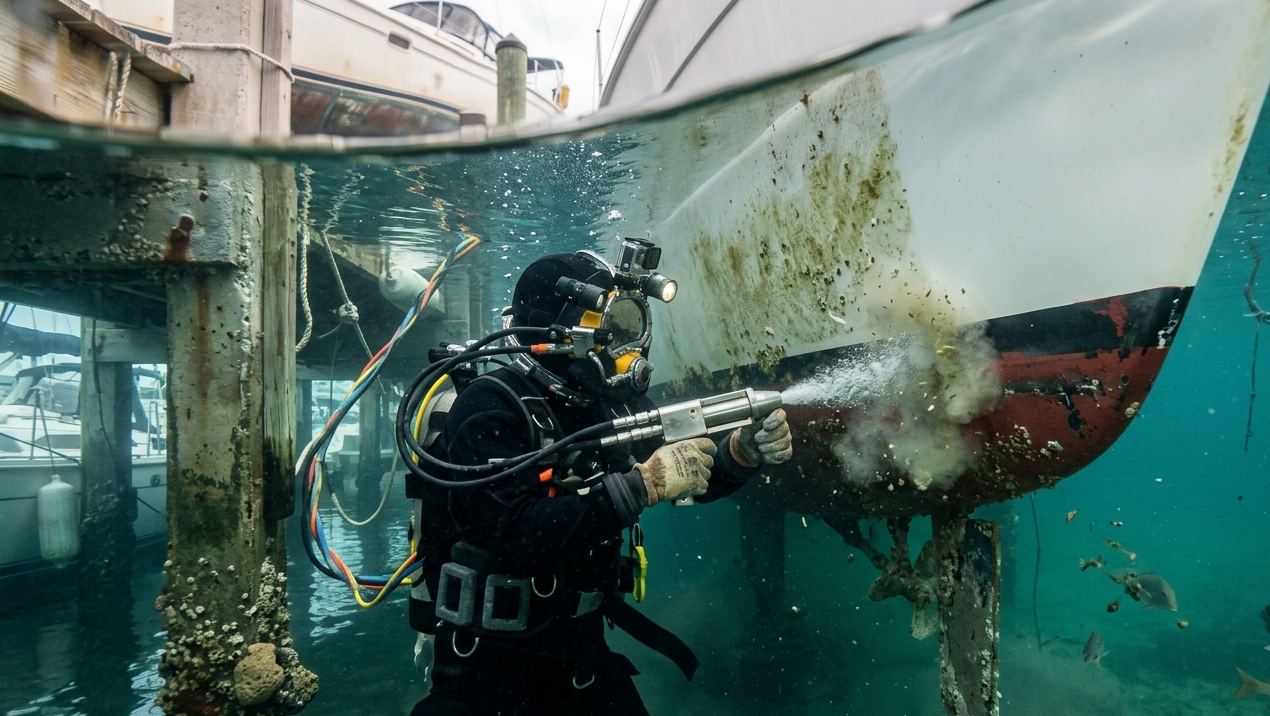
Cleaning a boat underwater does not have to mean adding another chemical to the water. When a vessel develops slime, algae, barnacles, or other marine growth, the traditional response can involve detergents, solvents, abrasive tools, or aggressive cleaning methods. But there is another approach: mechanical cleaning using controlled cavitation without chemical cleaners.
Zero-chemical marine cleaning can help remove marine growth while reducing the need to introduce cleaning chemicals into the surrounding water. For boat owners, marina operators, and commercial vessels operating in environmentally sensitive areas, that can be a meaningful advantage.
We also have to be realistic about what “eco-friendly” means underwater. Removing biofouling can itself release organisms, debris, coating particles, or other material into the water. The environmental benefit comes from choosing an appropriate cleaning method, controlling what is released, and following applicable local requirements—not simply calling a service “green.”
What Is Zero-Chemical Marine Cleaning?
Zero-chemical marine cleaning is an approach that removes underwater fouling through mechanical or physical action without relying on added chemical cleaning agents. Cavitation cleaning uses controlled bubbles generated in water to help loosen marine growth and deposits from suitable surfaces.
The attraction is straightforward: instead of applying a detergent, solvent, or biocidal cleaning product to loosen the fouling, the cleaning process relies on physical action.
That can reduce one potential source of chemical discharge during routine underwater maintenance. However, the method still needs to be matched to the vessel’s hull coating, equipment, fouling condition, location, and environmental requirements.
How Cavitation Cleaning Works Without Chemicals
Cavitation occurs when localized pressure changes in a liquid cause vapor bubbles to form and then collapse. In controlled cleaning applications, that physical phenomenon can be used to help disrupt deposits and marine growth.
The key difference is that the cleaning action comes from the water and equipment rather than from a chemical cleaner.
For marine maintenance, that can be useful where the goal is to remove fouling while minimizing unnecessary chemical inputs.
Why the Technique Matters Underwater
Underwater cleaning is different from cleaning a boat on land. Any material removed from the hull enters the surrounding environment unless the operation is specifically designed to capture or control it.
The International Maritime Organization’s biofouling guidance recognizes in-water cleaning as an important biofouling-management measure while also highlighting the need to address risks from released organisms, harmful substances, and damage to antifouling coatings.
Environmental Advantages of Zero-Chemical Marine Cleaning
1. Less Reliance on Chemical Cleaners
The most obvious benefit of biocide free maintenance is the reduction in reliance on chemical products during the cleaning operation.
Florida’s Department of Environmental Protection advises boaters to use cleaning methods and products that reduce risks to aquatic life. Its Clean Boating guidance specifically recommends avoiding cleaners containing harmful chemicals and using environmentally preferable products where cleaning products are necessary.
With a zero-chemical process, the cleaning action itself does not depend on adding detergent, solvent, or biocide to the water.
2. Reduced Risk of Chemical Discharge
Traditional cleaning products can become part of wastewater or rinse water. Once that water reaches a marina basin or other surface water, the substances it carries become an environmental consideration.
The Florida Clean Marina Best Management Practices specifically address this issue. The guidance says industrial wastewater from pressure washing should not be discharged to surface or ground waters, storm drains, or septic systems without appropriate controls, and recommends collection, recycling, treatment, or permitted discharge.
Using fewer chemical products can therefore simplify one part of pollution prevention, although it does not eliminate the need to manage the physical waste created by cleaning.
3. Supports Florida Marine Conservation Goals
Florida marine conservation depends on keeping pollutants, debris, and unnecessary contaminants out of coastal and inland waters.
Florida DEP’s Clean Marina Program encourages marinas and marine businesses to use environmental best management practices covering areas such as stormwater, waste management, spill prevention, and protection of sensitive habitats.
A cleaning method that reduces dependence on chemical products can fit naturally into that broader pollution-prevention approach when the operation is properly planned.
The Florida DEP Clean Marina Program is voluntary, so participation or use of a particular cleaning method should not be confused with regulatory approval or certification.
Zero-Chemical Does Not Mean Zero Environmental Impact
This distinction matters.
It would be misleading to say that any underwater cleaning process is automatically environmentally harmless simply because no chemical cleaner is used.
Biofouling can contain organisms capable of being transported to new locations. The IMO identifies hull fouling as an important pathway for the spread of invasive aquatic species and notes that in-water cleaning can release harmful waste substances or invasive species if it is not properly controlled.
The IMO’s 2023 Biofouling Guidelines were developed specifically to minimize the transfer of invasive aquatic species through biofouling.
That means responsible zero-chemical cleaning should consider more than the absence of detergent. It should also consider:
- What type of marine growth is being removed
- Where the vessel has been operating
- Where it will operate next
- Whether organisms or fragments could be released
- Whether antifouling coating could be damaged
- Whether removed material can be captured or controlled
- Local marina and environmental requirements
How Eco-Friendly Hull Cleaning Can Reduce Chemical Dependence
Eco-friendly hull cleaning is most effective when it is treated as part of a broader maintenance strategy rather than as a marketing label.
Regularly removing early-stage fouling can reduce the need for aggressive cleaning later. A lightly fouled hull is generally easier to maintain than a hull covered in mature barnacles and heavy calcareous growth.
The IMO notes that biofouling can begin accumulating within hours of immersion and that the amount and type of fouling depend on factors such as water temperature, salinity, vessel operation, location, and maintenance history.
That makes maintenance frequency part of the environmental conversation. Keeping fouling under control can potentially reduce the need for harsher interventions.
Why Biocide-Free Maintenance Can Matter for Boat Owners
Antifouling systems are designed to control marine growth, and some coatings contain biocides. Those products have an important function, but they also require responsible management.
The IMO’s Anti-Fouling Systems Convention addresses harmful substances in antifouling systems, while its biofouling guidelines focus on managing the transfer of organisms through hull fouling.
For routine maintenance, biocide free maintenance provides an option for removing accumulated fouling without adding another biocidal cleaning product to the operation.
That does not mean antifouling coatings should be removed or ignored. In fact, protecting the integrity of the existing coating is one of the most important considerations during underwater cleaning.
Protecting Antifouling Coatings During Cleaning
A cleaning method can create an environmental problem if it damages the coating that was designed to control fouling.
Florida DEP guidance recommends avoiding in-water scraping and abrasive processes that can remove antifouling paint from boat hulls. The Florida Clean Marina Guidebook specifically recommends avoiding underwater abrasive cleaning that can release antifouling paint into the water.
The IMO’s 2025 guidance on in-water cleaning also recognizes the need to address potential damage to antifouling coatings during cleaning operations.
For that reason, the cleaning method should be selected based on the actual hull coating and fouling condition—not simply because one method is faster.
Zero-Chemical Cleaning vs. Traditional Cleaning Methods
| Consideration | Zero-chemical cavitation cleaning | Traditional chemical-assisted cleaning |
|---|---|---|
| Added cleaning chemicals | Not required for the cavitation cleaning action | May involve detergents, solvents, or other products |
| Underwater chemical exposure | Can reduce reliance on added cleaning chemicals | Depends on the product and application |
| Marine growth removal | Physical cleaning action | May combine chemical and mechanical action |
| Coating considerations | Must be matched to the hull coating | Must also account for chemical compatibility and abrasion |
| Waste considerations | Removed organisms and debris still require environmental consideration | Removed material plus chemical residues may require management |
| Regulatory considerations | Still subject to location-specific rules and environmental controls | May involve additional considerations related to chemical discharge |
Common Mistakes With Green Boat Cleaning
Assuming “Chemical-Free” Means Automatically Compliant
EPA compliant hull cleaning is not a universal designation that can be applied simply because a service does not use chemicals.
Environmental compliance depends on the applicable federal, state, local, marina, permit, and water-quality requirements. Florida DEP’s Clean Marina guidance, for example, establishes specific best management practices for pressure washing, boat cleaning, and wastewater.
So the better approach is to describe a cleaning method accurately rather than making a blanket compliance claim.
Ignoring Removed Biofouling
If barnacles, algae, shell fragments, or other organisms are released into the water, the absence of chemicals does not make that release irrelevant.
Biofouling management is also a biosecurity issue. The IMO identifies hull fouling as a pathway for invasive aquatic species, making responsible removal and disposal or containment an important consideration.
Using Excessive Cleaning Force
More aggressive does not always mean better. Excessive force can damage coatings, fittings, sensors, or other underwater equipment.
The goal should be controlled removal of unwanted growth while preserving the vessel’s underwater systems and protective coatings.
Waiting Until Fouling Becomes Severe
Heavy mature fouling is harder to remove and may require more aggressive intervention. A regular maintenance schedule can help keep the problem manageable.
DIY vs. Professional Cavitation Cleaning
Some routine boat cleaning can be handled by owners, but underwater cavitation equipment and commercial marine cleaning require proper training and judgment.
A professional underwater team can assess the hull before cleaning, identify the type and severity of fouling, recognize sensitive equipment, and adjust the cleaning approach accordingly.
That matters around:
- Antifouling coatings
- Sonar transducers
- Sea chests
- Thrusters
- Propellers and running gear
- Underwater sensors
- Intakes and discharge fittings
- Other vulnerable underwater equipment
Our cavitation cleaning services use underwater mechanical cleaning rather than relying on chemical cleaning products to remove appropriate marine growth.
How Zero-Chemical Cleaning Fits Into Sustainable Marine Maintenance
Sustainable boat maintenance is rarely about one magic technique. It is about making a series of practical choices that reduce unnecessary environmental impact while keeping the vessel safe and operational.
That can include:
- Cleaning before fouling becomes severe
- Using the least aggressive effective cleaning method
- Reducing unnecessary chemical use
- Protecting antifouling coatings
- Preventing contaminated wastewater from entering surface waters
- Considering invasive-species risks
- Following local environmental requirements
- Documenting underwater maintenance
The IMO’s recreational boating biofouling guidance recognizes that recreational boats can transport invasive aquatic species and recommends appropriate biofouling management.
Why This Matters in Florida
Florida’s extensive coastline, warm waters, busy marinas, and large recreational boating community make responsible marine maintenance particularly relevant.
Florida DEP’s Clean Boating Programs promote pollution prevention and environmental stewardship across the state’s boating community. The agency encourages environmentally responsible practices and provides guidance for boaters, marinas, and marine businesses.
For a vessel that spends most of its time in a South Florida marina, choosing a maintenance approach that reduces unnecessary chemical inputs can be one part of a broader environmental strategy.
That does not replace proper waste management or regulatory compliance. It complements them.
FAQs About Zero-Chemical Marine Cleaning
What is zero-chemical marine cleaning?
Zero-chemical marine cleaning removes suitable underwater fouling through physical cleaning methods without relying on added chemical cleaners. Cavitation cleaning is one mechanical approach that can loosen marine growth through controlled physical action.
Is cavitation cleaning environmentally friendly?
Cavitation cleaning can reduce reliance on chemical cleaning products, but no underwater cleaning method is automatically environmentally harmless. Removed organisms, coating particles, debris, and invasive-species risks still need to be considered during the operation.
Does zero-chemical cleaning mean there is no pollution?
No. Removing marine growth can release organisms, debris, or coating material into the water. Responsible cleaning requires appropriate methods and controls for the specific vessel, location, fouling condition, and applicable environmental requirements.
Is zero-chemical hull cleaning EPA compliant?
There is no blanket EPA-compliant designation that applies simply because a hull-cleaning process uses no chemicals. Compliance depends on the applicable federal, state, local, permit, marina, and water-quality requirements.
Can cavitation cleaning damage antifouling paint?
Any underwater cleaning method can damage a coating if it is used incorrectly. The cleaning process should be matched to the coating condition and fouling type, with enough control to remove unwanted growth without unnecessarily removing intact antifouling material.
Does zero-chemical cleaning help Florida marine conservation?
Reducing unnecessary chemical inputs can support broader pollution-prevention goals, but responsible marine conservation also requires controlling removed biofouling, preventing contaminated discharges, protecting coatings, and following applicable Florida environmental requirements.
Read More: Discover more practical underwater maintenance techniques and environmental marine-service insights on the UMS marine maintenance blog.
Conclusion
Zero-chemical marine cleaning offers a practical way to reduce reliance on chemical cleaners during appropriate underwater maintenance. By using controlled physical cleaning rather than detergents or biocidal products, cavitation cleaning can fit into a broader strategy for responsible vessel maintenance.
But environmentally responsible cleaning is about more than what goes into the water. It is also about what comes off the hull, how biofouling is managed, whether coatings are protected, and whether the operation follows local environmental requirements.
For boat owners and marina operators, the best approach is a balanced one: clean regularly, use the least aggressive effective method, minimize unnecessary chemical inputs, protect the vessel’s coatings and equipment, and manage removed material responsibly.
Ready to protect your vessel?
If you need expert help with this, our team of certified divers and marine technicians is ready to step in. Learn more about our specific services here.
Prefer to speak with an expert immediately? Contact us today to schedule a service or get a free quote!
